# Standard Entities

## Standard Entities

### Article

<table data-header-hidden><thead><tr><th width="143">Field</th><th width="186">Required</th><th width="124">Format</th><th>Description</th></tr></thead><tbody><tr><td>Field</td><td>Required</td><td>Format</td><td>Description</td></tr><tr><td><code>title</code></td><td>Yes</td><td>String</td><td>The headline of the article</td></tr><tr><td><code>subTitle</code></td><td>No</td><td>String</td><td>The subtitle of the article</td></tr><tr><td><code>blurb</code></td><td>No</td><td>String</td><td>A summary of the article to display</td></tr><tr><td><code>date</code></td><td>No</td><td><a href="https://www.epochconverter.com/">Unix Epoch Timestamp</a></td><td>Date of publication</td></tr><tr><td><code>publisher</code></td><td>No</td><td>String</td><td>Name of the publisher</td></tr><tr><td><code>author</code></td><td>No</td><td>String</td><td>Name of the author</td></tr><tr><td><code>thumbnail</code></td><td>No</td><td>URL (could be a data url)</td><td>Image to be displayed - 106x106px</td></tr><tr><td><code>id</code></td><td>Must provide either <code>id</code> or <code>href</code>, or both.</td><td>String</td><td>An identifier used by the application to deeplink to the article</td></tr><tr><td><code>href</code></td><td>Must provide either <code>id</code> or <code>href</code>, or both.</td><td>URL</td><td>URL to the article (opened in a new browser window)</td></tr></tbody></table>

### Financial Objects

#### org.symphonyoss.fin.security

<table data-header-hidden><thead><tr><th width="112">Field</th><th width="102">Required</th><th width="90">Format</th><th>Description</th></tr></thead><tbody><tr><td>Field</td><td>Required</td><td>Format</td><td>Description</td></tr><tr><td>type</td><td>Yes</td><td>String</td><td>The type of object. Must be set to <code>org.symphonyoss.fin.security</code>.</td></tr><tr><td>id</td><td>Yes</td><td>Array of Objects</td><td>An array of one or more of the following objects: <em>org.symphonyoss.fin.security.id.ticker</em> org.symphonyoss.fin.security.id.isin <em>org.symphonyoss.fin.security.id.cusip</em> org.symphonyoss.fin.security.id.openfigi  More information about these objects is provided below.</td></tr></tbody></table>

#### org.symphonyoss.fin.security.id.ticker

<table data-header-hidden><thead><tr><th width="112">Field</th><th width="101">Required</th><th width="91">Format</th><th>Description</th></tr></thead><tbody><tr><td>Field</td><td>Required</td><td>Format</td><td>Description</td></tr><tr><td>type</td><td>Yes</td><td>String</td><td>The type of object. Must be set to <code>org.symphonyoss.fin.security.id.ticker</code>.</td></tr><tr><td>value</td><td>Yes</td><td>String</td><td>The name/ID of a ticker.</td></tr></tbody></table>

#### org.symphonyoss.fin.security.id.isin

<table data-header-hidden><thead><tr><th width="112">Field</th><th width="102">Required</th><th width="87">Format</th><th>Description</th></tr></thead><tbody><tr><td>Field</td><td>Required</td><td>Format</td><td>Description</td></tr><tr><td>type</td><td>Yes</td><td>String</td><td>The type of object. Must be set to <code>org.symphonyoss.fin.security.id.isin</code>.</td></tr><tr><td>value</td><td>Yes</td><td>String</td><td>The entity's ID.</td></tr></tbody></table>

#### org.symphonyoss.fin.security.id.cusip

<table data-header-hidden><thead><tr><th width="110">Field</th><th width="104">Required</th><th width="90">Format</th><th>Description</th></tr></thead><tbody><tr><td>Field</td><td>Required</td><td>Format</td><td>Description</td></tr><tr><td>type</td><td>Yes</td><td>String</td><td>The type of object. Must be set to <code>org.symphonyoss.fin.security.id.cusip</code>.</td></tr><tr><td>value</td><td>Yes</td><td>String</td><td>The entity's ID.</td></tr></tbody></table>

#### org.symphonyoss.fin.security.id.openfigi

<table data-header-hidden><thead><tr><th width="110">Field</th><th width="105">Required</th><th width="90">Format</th><th>Description</th></tr></thead><tbody><tr><td>Field</td><td>Required</td><td>Format</td><td>Description</td></tr><tr><td>type</td><td>Yes</td><td>String</td><td>The type of object. Must be set to <code>org.symphonyoss.fin.security.id.openfigi</code>.</td></tr><tr><td>value</td><td>Yes</td><td>String</td><td>The entity's ID.</td></tr></tbody></table>

### FDC3 Action buttons

FDC3 action buttons allow chat bots to embed buttons in messages which, on click, will raise an intent.&#x20;

Action buttons are only displayed to users who have a Desktop Integration Platform (DIP) set up, such as interop.io, Here Core or Connectifi.

Learn more about Desktop Interop and intents [here](/embedded-modules/desktop-interoperability.md).&#x20;

MessageML (`message` property)

```xml
<messageML> This is a FDC3 action button: 
    <br/>
    <span class="entity" data-entity-id="0">View Chart 
        <span class="tempo-text-color--red" style="font-size: 10px">
            <i>(Action button: Desktop Integration Platform is not available.) </i>
        </span>
    </span>
</messageML>
```

**Note**: Please see above the default text that would be displayed to users who don't have a desktop integration platform set up.

EntityJSON part (`data` property)

```json
{
"0":
    {
    "actionData":
        {
        "context":
            {
            "id":
                {
                "ticker": "TSLA"
                },
            "name": "Tesla, inc.",
            "type": "fdc3.instrument"
            },
        "intent": "ViewChart"
        },
    "label": "View a chart",
    "type": "fdc3.entity.action",
    "version": "1.2"
    }
}
```

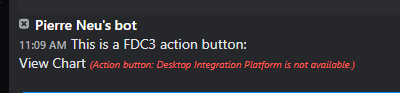
Display in Symphony:

{% tabs %}
{% tab title="Users with a DIP" %}

<figure><img src="/files/7fWxFemXXPL7djnFp7o7" alt=""><figcaption><p>On click, Symphony will raise the embedded intent.</p></figcaption></figure>
{% endtab %}

{% tab title="Users without a DIP" %}

<figure><img src="/files/gQUgFDkuM1pNP7JyUOAN" alt=""><figcaption></figcaption></figure>
{% endtab %}
{% endtabs %}

### Image

<table data-header-hidden><thead><tr><th width="112">Field</th><th width="102">Required</th><th width="98">Format</th><th>Description</th></tr></thead><tbody><tr><td>Field</td><td>Required</td><td>Format</td><td>Description</td></tr><tr><td>type</td><td>Yes</td><td>String</td><td>The type of entity. Must be set to <code>com.symphony.media.image</code>.</td></tr><tr><td>version</td><td>Yes</td><td>String</td><td>The version.</td></tr><tr><td>format</td><td>Yes</td><td>String</td><td>The data format. Must be set to <code>image</code>.</td></tr><tr><td>url</td><td>Yes</td><td>String</td><td>The URL of the image.</td></tr></tbody></table>

### Taxonomy (mention)

<table data-header-hidden><thead><tr><th width="112">Field</th><th width="97">Required</th><th width="104">Format</th><th>Description</th></tr></thead><tbody><tr><td>Field</td><td>Required</td><td>Format</td><td>Description</td></tr><tr><td>type</td><td>Yes</td><td>String</td><td>The type of object. Must be set to <code>com.symphony.user.mention</code>.</td></tr><tr><td>version</td><td>Yes</td><td>String</td><td>The object's version.</td></tr><tr><td>id</td><td>Yes</td><td>Array of objects</td><td>An array of one or more of the following objects: <br>• com.symphony.user.userId<br>More information about these objects is provided below.</td></tr></tbody></table>

#### com.symphony.user.userId

<table data-header-hidden><thead><tr><th width="112">Field</th><th width="103">Required</th><th width="104">Format</th><th>Description</th></tr></thead><tbody><tr><td>Field</td><td>Required</td><td>Format</td><td>Description</td></tr><tr><td>type</td><td>Yes</td><td>String</td><td>The type of object. Must be set to <code>com.symphony.user.userId</code>.</td></tr><tr><td>value</td><td>Yes</td><td>String</td><td>The ID of a user.</td></tr></tbody></table>

### Video

<table data-header-hidden><thead><tr><th width="112">Field</th><th width="101">Required</th><th width="107">Format</th><th>Description</th></tr></thead><tbody><tr><td>Field</td><td>Required</td><td>Format</td><td>Description</td></tr><tr><td>type</td><td>Yes</td><td>String</td><td>The type of object. Must be set to <code>com.symphony.media.video</code>.</td></tr><tr><td>version</td><td>Yes</td><td>String</td><td>The version.</td></tr><tr><td>format</td><td>Yes</td><td>String</td><td>The video's format. Must be set to <code>youtube</code> or <code>vimeo</code>.</td></tr><tr><td>url</td><td>Yes</td><td>String</td><td>The URL of the video.</td></tr><tr><td>id</td><td>Yes</td><td>String</td><td>The unique ID of the video (can be extracted from the video URL).</td></tr></tbody></table>

## Go further...

Continue here to learn more about structured objects:

{% content-ref url="/pages/-MB59Ee8TySm0PQhxmFF" %}
[Custom Entities](/bots/messages/overview-of-messageml/entities/structured-objects.md)
{% endcontent-ref %}


---

# Agent Instructions: Querying This Documentation

If you need additional information that is not directly available in this page, you can query the documentation dynamically by asking a question.

Perform an HTTP GET request on the current page URL with the `ask` query parameter:

```
GET https://docs.developers.symphony.com/bots/messages/overview-of-messageml/entities/standard-entities.md?ask=<question>
```

The question should be specific, self-contained, and written in natural language.
The response will contain a direct answer to the question and relevant excerpts and sources from the documentation.

Use this mechanism when the answer is not explicitly present in the current page, you need clarification or additional context, or you want to retrieve related documentation sections.